
Susono Komyoji Temple preserves a number of historic Buddhist statues
representing different periods of Japanese Buddhist art.
The following descriptions are based on the results of a comprehensive survey
published by the Susono City Board of Education in 2001.
Reference:
Susono City Board of Education,
Susono no Butsuzo: Susono-shinai Butsuzo Shikkai Chosa Hokokusho
[Buddhist Statues of Susono: Comprehensive Survey Report of Buddhist Statues in Susono City],
Kowa Printing, 2001, p. 109.
Six Historic Buddhist Statues
Jizo Bodhisattva (Kshitigarbha), Seated with One Leg Lowered
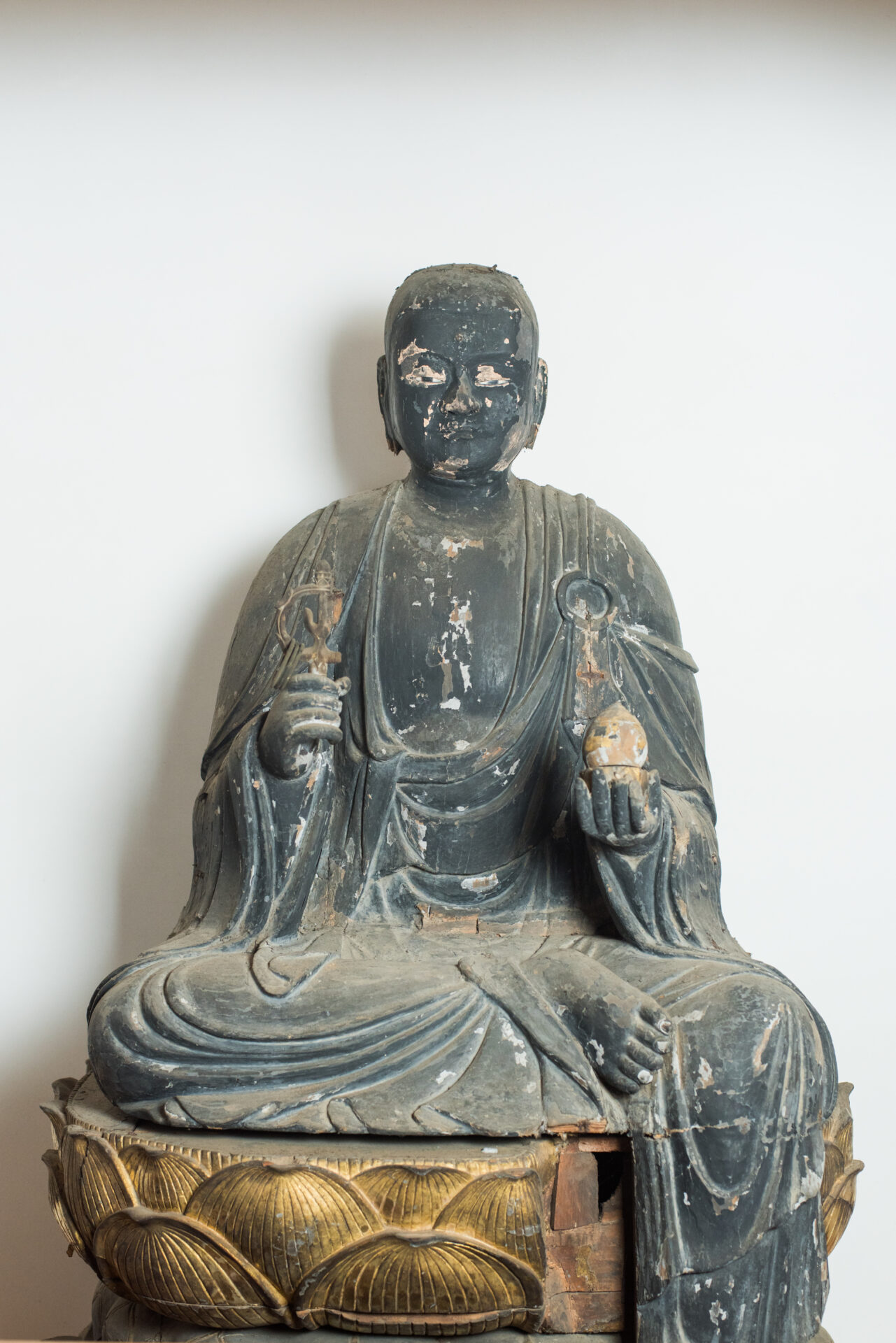
Jizo Bodhisattva (Kshitigarbha), the principal image of Susono Komyoji Temple
Size: Height 83.4 cm
Overview: Wood, joined-block construction (yosegi-zukuri), inlaid crystal eyes (gyokugan), polychrome
Date: Face: Nanboku-cho period / Body: Edo period
This statue is the principal image of Komyoji Temple and is enshrined
on the central altar of the main hall.
Jizo holds a sacred jewel in his left hand and a monk’s staff
in his right hand. He is seated with his left leg lowered from the pedestal.
He wears Buddhist monastic robes consisting of a no-e, hensan,
kesa, and kun.
The statue is made using joined-block wooden construction
and has inlaid crystal eyes. Its present surface is covered with
polychrome decoration added during a later restoration.
In its construction, the head is formed from front and rear sections
joined along a line running behind the ears and is inserted into the body
below the three neck folds. The torso is also basically constructed
from front and rear sections, with thin additional pieces inserted
between them.
Separate pieces are joined to form both sides of the body,
the legs, the lowered leg, and both forearms, while the hands are inserted
separately.
The head and body are hollowed internally. On the front section
of the torso, part of the wood toward the rear was intentionally
left in the form of a board. A rectangular opening was made
in the back of the statue and fitted with metal hardware so that
it could be opened and closed.
Inside the statue are inscriptions recording dates including
Kan’en 2 (1749), together with the names of many people connected
with the restoration or dedication of the image.
Two wooden tablets, dated Kansei 9 and Keio 3, were also found inside,
together with one volume of the Daihannya Haramitta-kyo
(Great Perfection of Wisdom Sutra) and one volume of the
Hannya Rishukyo.
In terms of the overall proportions of the statue, the relatively
small size of the head is particularly noticeable.
There is also a clear difference in sculptural expression:
the face shows subtle modeling of the flesh, while the body is treated
in a considerably more conventional manner and the folds of the robes
have become formalized.
For these reasons, the head and body are considered to have been
made at different times. The head has a powerful and masculine facial
appearance combined with a somewhat distinctive expression,
suggesting that it was created during the Nanboku-cho period.
The body, on the other hand, appears to be a later reconstruction
from the Edo period. Based on the inscription inside the statue,
it is thought to have been produced around Kan’en 3.
An inscribed wooden tablet also confirms that repairs were carried out
in Kansei 9 (1797).
Although the body is a later reconstruction,
the head preserves an excellent example of medieval sculptural style.
The survival of inscriptions and objects deposited inside the statue
is also unusual within Susono City, making this an important example
from both historical and art-historical perspectives.
Seated Yakushi Nyorai (Bhaisajyaguru / Medicine Buddha)
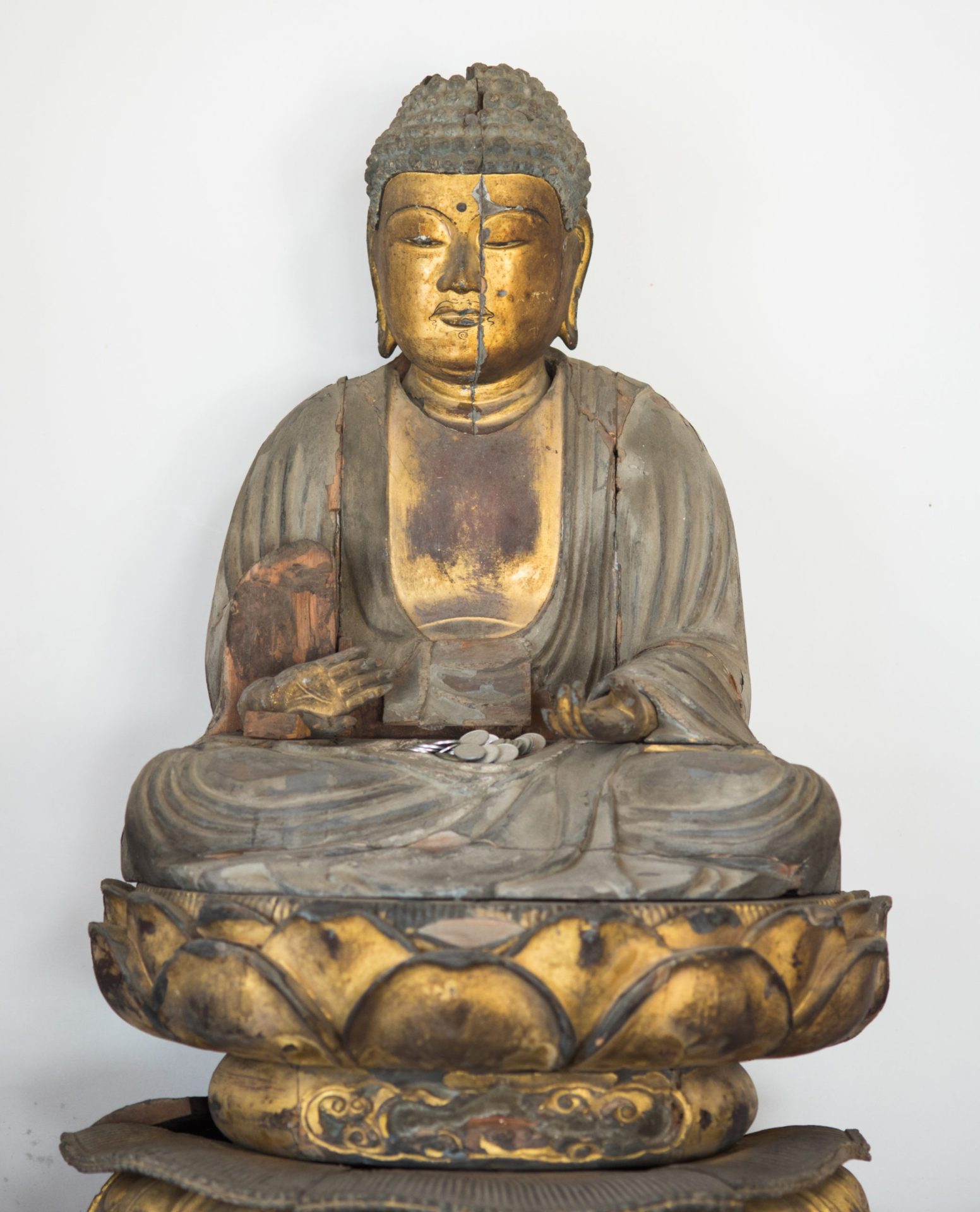
Seated Yakushi Nyorai (Bhaisajyaguru / Medicine Buddha)
Size: Height 99.0 cm
Overview: Wood, joined-block construction (yosegi-zukuri), inlaid crystal eyes (gyokugan), lacquer and gold leaf on the flesh, brown lacquer on the robes
Date: Edo period
Seated Dainichi Nyorai (Mahavairocana)
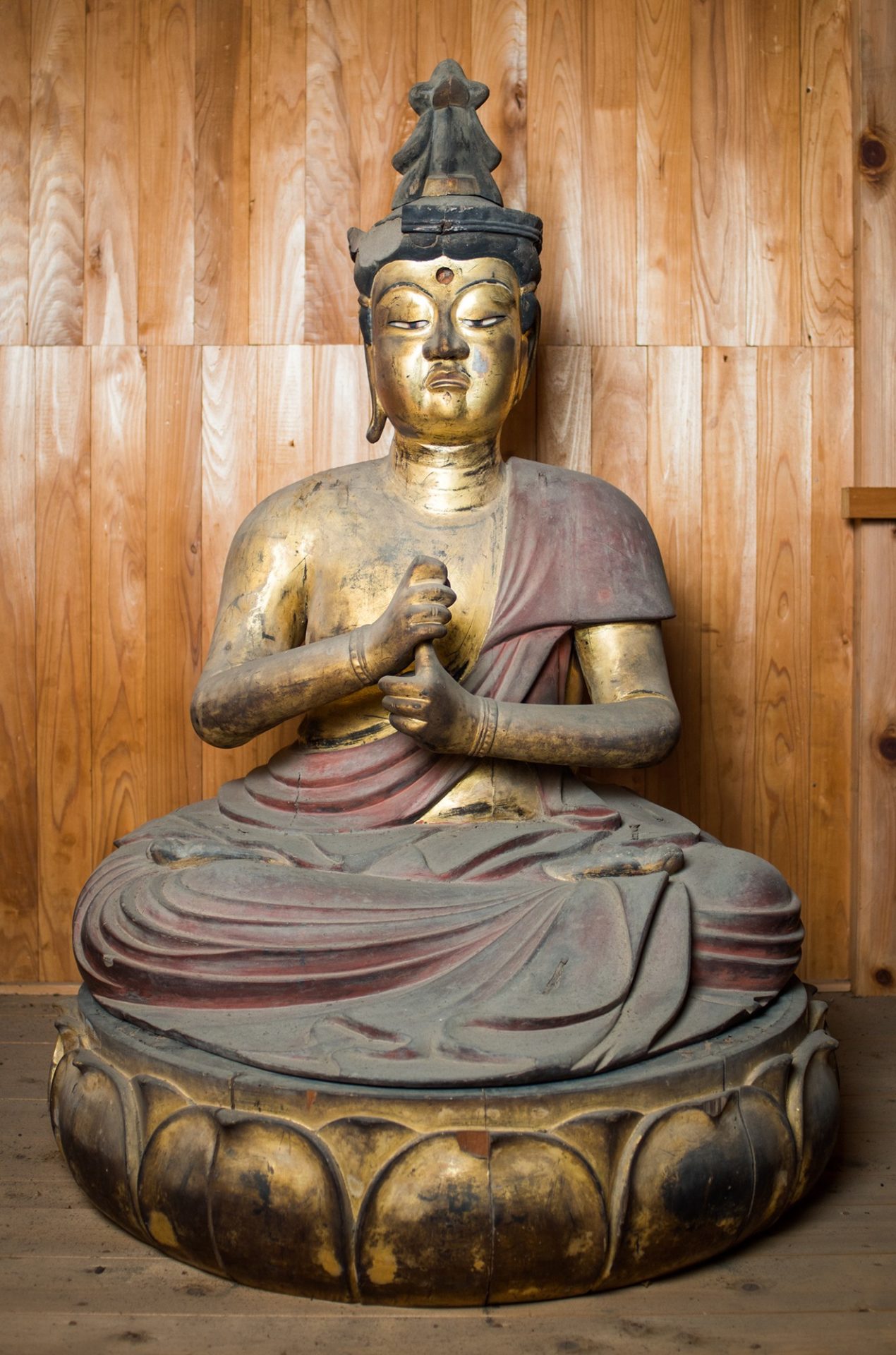
Seated Dainichi Nyorai (Mahavairocana)
Size: Height 54.1 cm
Overview: Wood, joined-block construction (yosegi-zukuri), inlaid crystal eyes (gyokugan), lacquer and gold leaf on the flesh, lacquered robes
Date: Muromachi period
This statue is enshrined on the altar of the Kanno-do Hall
in a position corresponding to the principal image.
The statue represents Dainichi Nyorai of the Diamond Realm,
forming the Chiken-in mudra with the hands.
The hair is arranged in a high topknot.
The figure wears a johaku sash and a kun lower garment,
and sits in the full lotus position with the right leg placed above the left.
The statue is made using joined-block wooden construction
and has inlaid crystal eyes. The flesh areas are finished with lacquer
and gold leaf, while the robes are coated with brown lacquer.
The head consists of front and rear pieces joined along a line
running behind the ears and is inserted into the torso.
The torso is basically composed of front and rear sections.
Between these sections, additional pieces of wood were inserted
at the shoulders and at the lower part of the body to increase
the depth of the figure.
Separate sections form the legs and the front of the lower garment,
while paired pieces are joined on either side of the waist.
Both the head and body are hollowed internally.
The left arm is joined at the shoulder, elbow, and wrist.
The right arm is joined at the middle of the upper arm and at the wrist.
The topknot is made from three pieces of wood,
while the base of the crown consists of five pieces.
The present surface of the statue may be the result of a later restoration.
The lower part of the left earlobe, part of the hair on the front right side
of the head, and the urna on the forehead are missing.
Seated Buddha, Traditionally Identified as Amida Nyorai (Amitabha Buddha)

Seated Buddha traditionally identified as Amida Nyorai (Amitabha Buddha)
Size: Height 88.6 cm
Overview: Wood, joined-block construction (yosegi-zukuri), inlaid crystal eyes (gyokugan), lacquer and gold leaf on the flesh, lacquered robes
Date: Muromachi period
The seated Buddha holds the left hand palm upward on the knee
with all five fingers extended. The right arm is bent forward
at the elbow, with all five fingers extended and the palm facing outward.
The hands therefore form gestures corresponding to the
abhaya mudra, symbolizing freedom from fear,
and the varada mudra, symbolizing the granting of wishes.
The figure wears a Buddhist robe and lower garment
and sits in the full lotus position.
Its basic construction is similar to that of the Dainichi Nyorai statue.
On the left side of the body, front and rear pieces running
from the shoulder to the base are joined together.
The forearm section is attached separately and the hand is inserted.
The right arm is joined at the elbow and wrist.
The left eye and the present surface of the statue are later restorations.
Parts of the top of the head, the opening of the left sleeve,
and several fingertips are missing.
This statue and the Dainichi Nyorai share several stylistic characteristics:
relatively large heads, bodies with considerable depth,
realistic facial features with a distinctive and somewhat tenacious expression,
and comparatively conventional treatment of the folds of the robes.
Their dimensions are also similar.
For these reasons, the two statues are thought to have originally
formed part of the same group. Based on their style,
they are believed to have been created around the middle
of the Muromachi period.
As substantial, approximately life-size examples of Buddhist sculpture
from the Muromachi period, they are important works within Susono City.
Although this statue has traditionally been identified as Amida Nyorai,
the position of the hands suggests that it is unlikely to represent Amida.
It may instead depict Shaka Nyorai (Shakyamuni Buddha)
or Yakushi Nyorai (Bhaisajyaguru).
Komyoji is traditionally said to have belonged to the Shingon Buddhist tradition
in an earlier period. When this tradition is considered together
with the presence of the Dainichi Nyorai statue,
it is also possible that the two statues once formed part
of a group of the Five Wisdom Buddhas,
and that this seated Buddha was originally one figure within that group.
Standing Fudo Myoo (Acala)
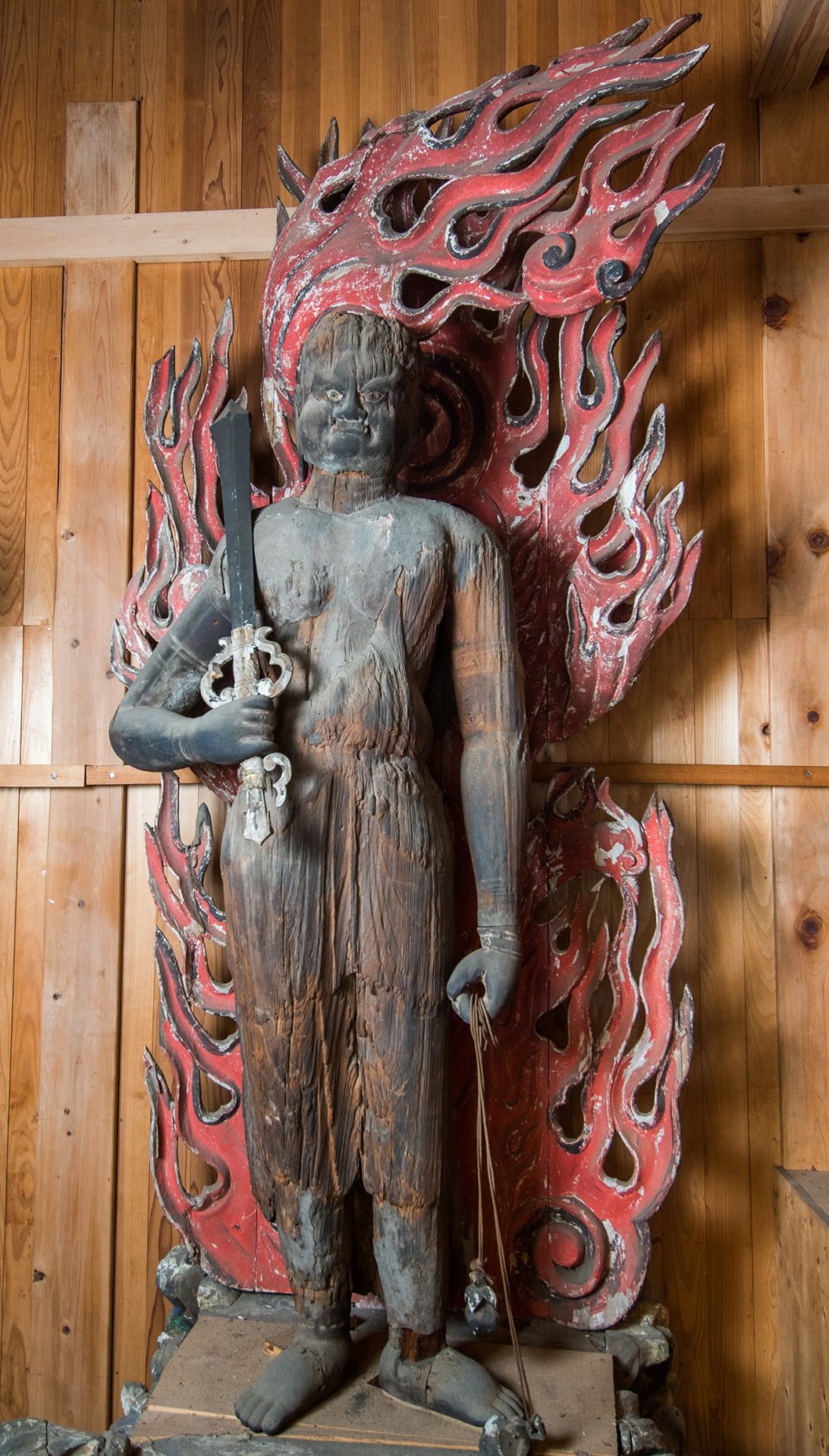
Standing Fudo Myoo (Acala), late Heian period
Size: Height 163.8 cm
Overview: Wood, single-block construction (ichiboku-zukuri), carved eyes, presently unpainted wood
Date: Late Heian period
The hair is rendered in curls, with a braided lock originally falling
over the left shoulder, although this section is now missing.
Both eyes are wide open and fangs project from the lips.
The present facial features, however, were formed by building up
kokuso paste over the wooden surface and are a later restoration
of an area that had suffered deterioration.
The figure wears a johaku sash and a lower garment with the upper edge folded over,
together with a cloth wrapped around the waist.
Armlets are worn on the upper arms and wrists.
The head and torso, including the left arm as far as the forearm,
are carved from a single piece of wood.
The material is thought to be either kaya or hinoki cypress.
The wood core is positioned slightly to the right of the front
of the head, and the statue has not been hollowed internally.
The section beyond the right shoulder, the left hand,
both feet below the ankles, both ears, nose, eyebrows,
lower lip, attributes held by the figure, pedestal,
and halo are later replacements.
The generous modeling of the chest and abdomen,
together with the broad and relaxed posture in which the waist
twists slightly to the right, suggests that the statue
was created during the late Heian period.
Standing Bishamonten (Vaisravana)
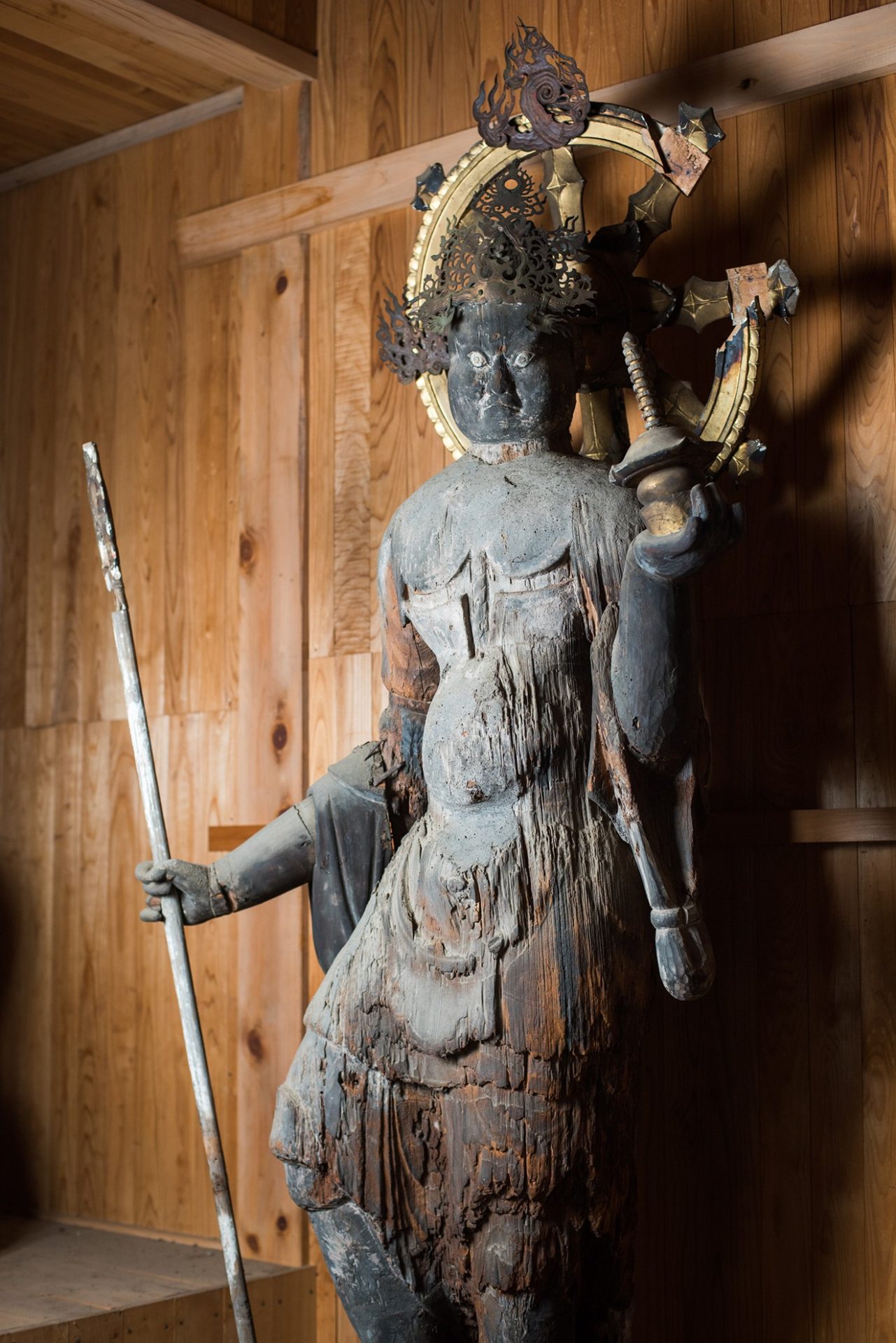
Standing Bishamonten (Vaisravana), late Heian period
Size: Height 169.0 cm
Overview: Wood, single-block construction (ichiboku-zukuri), carved eyes, presently unpainted wood
Date: Late Heian period
The figure wears the hair in a topknot and a copper crown,
which is a later addition.
The eyebrows are raised and the eyes opened wide in an expression of anger,
while the mouth is firmly closed.
Bishamonten wears armor, holds a miniature pagoda in the left hand
and a halberd in the right, twists the waist toward the left,
and stands upon a defeated demon.
The head and torso, including the topknot and both arms as far as the elbows,
are carved from a single piece of wood.
The material is thought to be either kaya or hinoki cypress.
The statue has not been hollowed internally.
Separate pieces are joined beyond both elbows,
including the portions of the large sleeves hanging from the elbows.
The right forearm and sleeve, the left forearm,
the lower half of the left sleeve, both legs below the mid-shin,
the halberd, miniature pagoda, demon, pedestal, and halo
are later replacements.
The free-hanging sections of the celestial scarf that originally
descended forward from both shoulders are missing.
The head is relatively small in comparison with the tall body,
producing somewhat unusual proportions.
However, the bold use of a single block of wood is characteristic
of an older sculptural tradition.
The relatively static posture, slender body,
and shallow carving of features such as the face indicate
that the statue was created during the late Heian period.
Creating Fudo Myoo and Bishamonten as a paired group
is a practice known from the Heian period.
The central image accompanied by such a pair could include
Amida Nyorai in an Amida triad, or an Eleven-Headed Kannon.
Together with the seated Dainichi Nyorai,
these statues are valuable as rare examples of ancient Buddhist sculpture
surviving in Susono City from the Heian period.
The Story of Fudo Myoo and Bishamonten in 1590
Komyoji is said to have been burned in 1590 during
Toyotomi Hideyoshi’s campaign against Odawara Castle.
According to a story passed down at the temple,
local devotees attempted to protect precious Buddhist statues
from the fire by hiding them in a nearby wet rice field.
After the conflict, people are said to have heard voices coming
from the rice field. When the area was dug up,
the statues of Fudo Myoo and Bishamonten were discovered.
These two statues, both believed to date from the late Heian period,
have therefore been preserved for approximately 1,000 years
and continue to be objects of Buddhist devotion at Komyoji today.